Singapore robotic-hands firm Sharpa joins Nvidia and Unitree on humanoid robot project
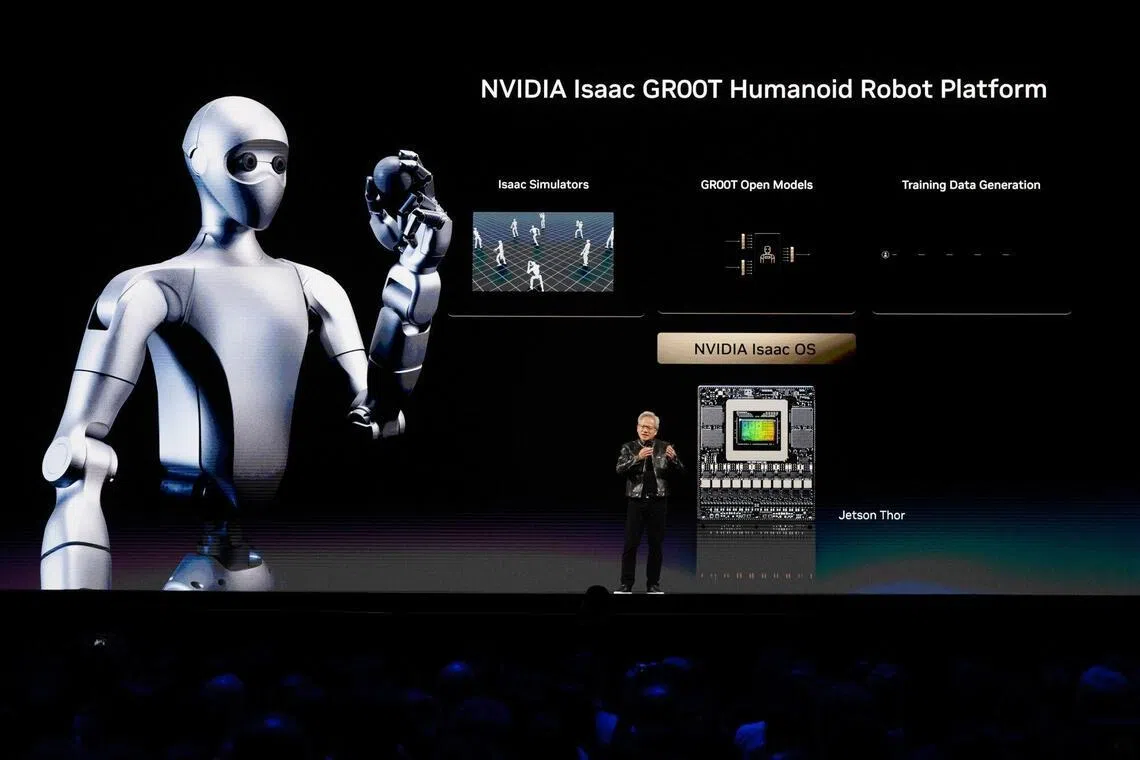
| Nvidia CEO Jensen Huang speaking about the computing giant's Isaac GR00T Reference Humanoid Robot on the sidelines of the Computex conference in Taipei on June 1. PHOTO: BLOOMBERG | TAIPEI – A future where robots can be deployed en masse to perform delicate tasks on manufacturing lines or in hospitals to care for the sick has come closer to reality, with a collaboration between Singapore-based robotic-hands company Sharpa, computing giant Nvidia, and Chinese robot maker Unitree. They are collaborating to roll out humanoid robots in late 2026 to researchers, to help them train robot brains for tasks requiring precise hand movements – such as assembling a computer or administering an intravenous drip, a tall order for robots. The tie-up was announced by Nvidia chief executive officer Jensen Huang in a highly anticipated keynote address on June 1, on the sidelines of the Computex conference in Taipei, Asia’s biggest tech expo. “Humanoid robots will bring physical AI to the world’s largest industries, opening a multitrillion-dollar economic opportunity,” said Huang, during his address at the Taipei Music Center that drew a packed audience and was broadcast to 70 watch parties across Taipei. The Nvidia Isaac GR00T Reference Humanoid Robot or H2 Plus – which features Sharpa’s 22-degrees-of-freedom robotic hands designed to mimic the dexterity and tactile sensitivity of human hands – is the Singapore-headquartered company’s biggest collaboration to date. Nvidia’s vice-president of physical AI simulation, Rev Lebaredian said Sharpa’s robotic hands allow researchers to train robot brains for tasks that require grasping, handling, adjusting, and using objects with greater precision. “That matters because the ‘brain’ of a humanoid robot is not just about understanding the world – it has to learn how different actions feel and behave on real hardware. The hands give researchers the data and physical feedback needed to connect robot learning with manipulation skills that can transfer to real-world tasks,” said Lebaredian. |